Pages

Showing posts with label beetles. Show all posts

Sunday, May 21, 2017

What a difference a week makes...

I was recently chatting to a fellow beetler who reminded me of a section in the Coleopterists handbook about how to attract species of beetles that utilise the various stages of decaying carcasses. The idea implanted and I decided to have a go. What's the worse that could happen?

The perfect receptacle seemed to be an old Cambridgeshire Council recycling box filled up with about 4-5 inches of sand (courtesy of B&Q).

All I needed now was a body.....any body.

Over the following few days I came across lots of dead badgers and a couple of muntjac, all of which were just too big for the box. What a I really needed was a rabbit......

But just when I really needed one, rabbits at the perfect point of death were non existent. However fate was at hand as I drove to the tip one Saturday and saw what appeared to be a dead duck by the side of the road.

On the return trip (much to the embarrassment of my son) I stopped and examined the freshly dead female Mallard. The apparent victim of hit and run. In to the car she went and once home, she was lovingly placed on the bed of sand. 


I then covered the box with some plastic chicken wire and attached it firmly to the box to prevent any foxes or badgers making off with my hard won quarry!

All that was left to do was wait......

A week went by and the temperatures weren't too high. I went to check the duck which had now been christened 'Donald' despite the obvious sexual misnomer.

A few blowflies were on the carcass but when I turned it a small beetle tried to hide in the sand (what appears to be a histerid(?) but need some further work to ID). This was potted and the duck was returned to its resting state.

A week later (today) and on returning home after 3 rather lovely days on the Gower peninsula in south Wales (more on that later) I decided to check on 'Donald'.........

Wow, almost no flesh left and a writhing mass of thousands of maggots.


A bit of a more thorough investigation revealed 3 (possibly 4) species of staph which have now all been collected to put under the 'scope for IDing. Let's hope that goes better than some of my previous goes at staphs......

Just to give you the full immersive experience. Here's a short video (plus guest appearing staph)!!

Monday, April 17, 2017

The benefits of a collection

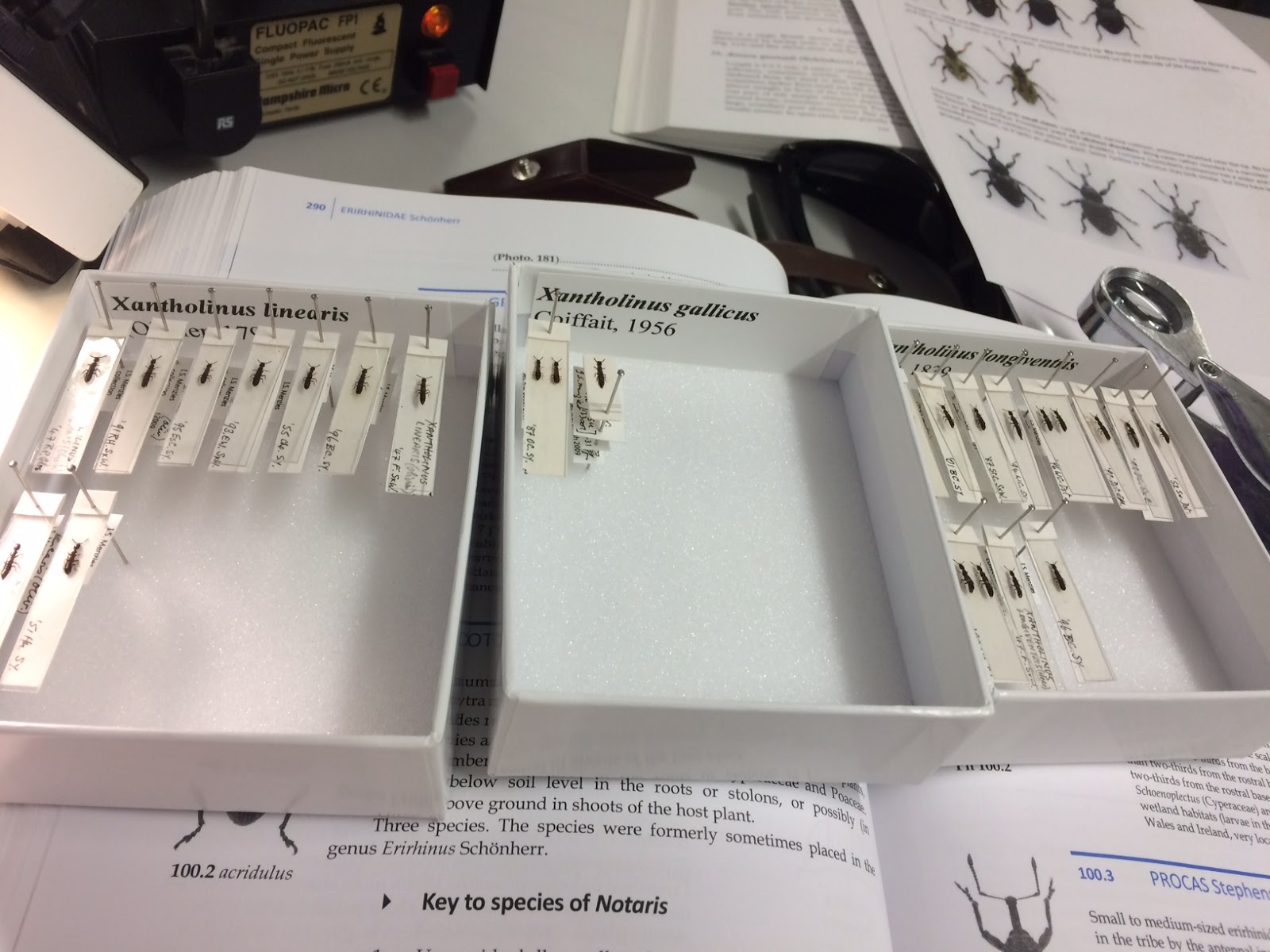
In a recent post I was struggling with some comparative features of a Xantholinus rove beetle. From the keys it seemed like gallicus was the best fit but as I had limited-to-zero experience with that genus, I took the specimen down to the NHM when I visited earlier this month for the weevil workshop.

Max Barclay kindly got out the examples from the NHM's British collection of that genus and once I had them all lined up it was clear that my specimen was a linearis the most regularly encountered member of the genus.

The NHM's British specimens of Xantholinus
gallicus. These looked distinctly different to my specimen,

This reinforced the importance of being able to compare things to a well curated reference collection as many of these features only become clear when you can compare 100s of individuals side by side. Later in the day this was even more relevant as we looked at Sitona weevils!!

I also had a look at a few light-trapped Amara that I have kept hold of and compared them to similar species in the NHM collection.. I think they are consularis but this genus seems particularly subjective so I'll hang on for further specimens to compare to!


A selection of Amara

Sunday, April 9, 2017

Fear no weevil


I've not really delved much into weevils apart from the glaringly obvious ones. I collected a few last year but had ended up putting them in the box of unidentified beetles.

This all changed on April 1st when I attended a weevil workshop run by Mark Gurney (Weevil scheme organiser) and hosted at Natural History Museum by Max Barclay.

The two main things I learned (apart form lots about weevils) was
1. I need a better microscope
2. having a range of specimens to compare to is invaluable.

It was a great day and I learned a fair bit. It was great to have someone there to help you spot your mistakes and by the end of the day I had managed to put a name to all the weevil specimens I had brought with me.

Max also gave us a tour of the beetle collection at the NHM which was an unexpected bonus and impressive in its scale.

Also met some other folk with similar interests which is always nice.

All in all a grand day out.

Check out Mark's free guides to the British weevils here.


Exapion ulicilis. Only 3 or 4 of millimetres. Rather pleased with my carding! 

Monday, February 20, 2017

Out with the experts

I've been rather slack in blogging partly because I've not really been doing much natural history apart from finishing going through last year's beetles.

However, just over a week ago I had the opportunity to meet up with some folk for some valuable beetling experience. A trip to Wicken Fen with Mark Telfer, Steve Lane, Tim Hodge and Bill Mansfield was an invaluable experience and also added a good few new beetles to my list.

It was an opportunity to see two of the UK's top beetle experts in the field and having them to filter the IDs and explain the various ID criteria was a huge plus.

We spent most of our time sieving a couple of the big piles of cut-reed debris and turned up a good number of staphs and carabids plus some other bits and pieces. Nothing out the ordinary and we are still finalising the list but Mark recorded (I think) a new species for the Wicken list. Best looking beetle I think had to be Lordithon lunulatus.


It was a cold day and even snowed as we made our way back to the car park. What was a good lesson to learn was only to collect a manageable number of beetles. I now have a set of lovingly carded beetles added to my reference collection.

Also a reminder of how good it is to get out with people who really know their stuff. You just sort of learn by osmosis (plus copious listening and question asking).

Thanks all


Monday, March 7, 2016

Carding beetles

It's one of those jobs that any coleopterist has to get to grips with and one that gets easier the more one does it..... allegedly.

I have to admit that I secretly enjoy it but I still find beetles under 5mm a real chore and struggle to get all their bits in perfect symmetry.

A couple of things prompted this post. I've recently been finishing last year's backlog of beetles from the fridge in readiness for the new season that is now upon us and I will say that I'm (sadly) rather excited about a few imminent days in the field pootling (or should that be pootering) about on my hands and knees.

I was taking some pics down the microscope of a beetle that I was having trouble with. In retrospect it was an easy beetle, but I just couldn't make out a couple of key details to clinch the ID. In this case an elytral pore near the scutellum. The beetle in question was a Calodromius spilotus, collected from some recently pollarded willow in my garden.


I also found a couple of staphs on a recent trip to Cornwall which I have duly carded and put to one side while I await the more expensive of the 2 of Derek Lott's staph books.


The other thing that has prompted this post is a video that was recently posted on the UK Beetles Facebook page by Mark Telfer all about his carding technique. Worth a watch. Happy carding!


Sunday, November 8, 2015

Continental beauties

I've been spending some much needed time categorising and sorting out a whole load of images. I have 10s of 1000s of images on my computer and several hard drives. It's a slow process but should hopefully be worthwhile in the long run.

I occasionally find stuff that I'd completely forgotten about and that was the case with a folder from June 2008 entitled Beetles. The pictures were all taken of beetles that had turned up in my moth trap over a 2 week period whilst on holiday in the Cevennes region of France.

I remember being pretty blown away by them at the time but given my recent shift in interest toward coleoptera it was rather nice to be reminded of them.

Calasoma sychophanta

European Rhinoceros Beetle

Saperda scalaris

Female Stag Beetle